
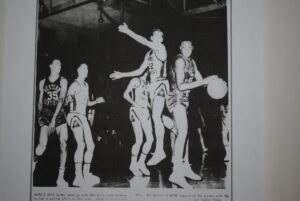
*Picture during my college days at MTSU “trying” to guard Western Kentucky All-American Clem Haskins
March is the time of year when basketball fans get “pumped up” with the anticipated tournament games of March Madness. The excitement builds from the conference tournament games and continues through the announcement on Sunday of the 68 teams that are invited to play in the NCAA Basketball Tournament. The whole month of March has taken on its own life with terms like Bracketology, Bracket Busters, Sweet Sixteen, Elite Eight, First Four In, Bubble Watch, etc. It is estimated that over 3 billion dollars will be bet on this year’s tournament. It is a great time to be a college basketball fan unless you are a college coach that has not had a very good season or even if you had a successful season but your team did not make the tournament. Too often making the tournament and making a deep run in the tournament determines whether a coach keeps his job. The “regular” season seems to be less important. Cha-ching.
Rather than focus on the NCAA Tournament I want to focus on these coaches that I think revolutionized college basketball. (Interestingly, all five of these coaches made deep runs in the tournament, three of the five won a national championship.) These coaches won a lot of games but what sets them apart from other great coaches was how their teams played the game. They all had a “unique” style. They changed the way the game was played by their offense, defense, their recruiting, their style, their innovative concepts. I am NOT saying that these five coaches are the greatest college basketball coaches but I am saying that these coaches were “different” in their approach to the game. Some might even call them “rebels”. These are five coaches that I think were ahead of their time.
The first coach that I remember as being “different” was E.A. Diddle, who coached at Western Kentucky from 1922 to 1964. Coach Diddle was already a legend when he came to my house in 1962 to recruit me out of high school. He was 66 years-old and needed help to climb the 5 steps leading up to our front porch. I was honored that he would travel the 160 miles from Bowling Green, Ky to Galatia, Il to personally talk to me. He was the first coach to coach 1,000 games at one school. His overall record was 759-302. What set him apart was his fast-break style of play and his bench excitement during the game. He would wave a red towel around during the game to excite the crowd. He was an outstanding recruiter and always maintained that he was an entertainer as much as a basketball coach. He was responsible for breaking the color barrier at WKU. (Clem Haskins and Dwight Smith were two of his recruits that became outstanding players.) The current basketball arena is named after him. *Picture above is of Middle Tennessee State vs Western Kentucky, #22 Jack Sutter and All-American Clem Haskins.
I didn’t sign to play at Western Kentucky but signed a scholarship at the University of Missouri. I was from a small town in southern Illinois and decided after one semester that Mizzou was too big for me. I started looking around for a smaller D1 school and found that school in Middle Tennessee State University. MTSU was coached by another one of my “maverick” coaches, Ken Trickey. Coach Trickey was from southern Illinois (Cairo) and had recruited several players from southern Illinois that I knew. MTSU had about 4,000 students and the small town atmosphere was what I grew in and felt comfortable with. Like Coach Diddle, Coach Trickey emphasized fast break basketball. After he left MTSU to coach at Oral Roberts University his offense was referred to by the media as WRAG (We Run and Gun). Also, like Coach Diddle, Coach Trickey was the first basketball coach at MTSU to recruit African-American players. (He and a HOF track coach named Dean Hayes integrated the athletic program at MTSU.) Before Coach Trickey left Murfreesboro, Tn, recognized for having been the sight of several Civil War battles, he would be the first college basketball coach in any conference in Tennessee to start an all black team. I played for him for three years and later served on his staff at ORU. His ORU teams finished in the top 5 in scoring and led the nation in scoring in the 1970-71 season with an average of 105 points a game. In his five years at ORU his teams were 118-23. No school in the history of the NCAA has gone from a NAIA program to playing in the Elite Eight in a shorter period of time. The Titans (now known as the Golden Eagles) went to two NIT’s. After only four years as a D1 program ORU played Kansas in the Mid-West Regional for a chance to play in the Final Four. Ken Trickey, had a tremendous influence on the way basketball was played in Oklahoma. He was a true visionary and altered how the game of basketball was played in a state once dominated by HOF Oklahoma State coach Henry Iba.
During my five years on Coach Trickey’s staff at ORU we played against some great teams that were coached by great coaches, one of those men stands out as a “revolutionary” coach. Jerry Tarkanian, who was called “Tark the Shark” became a legend in college coaching at the University of Nevada Las Vegas. He was an outstanding coach long before he coached at UNLV. Our ORU teams played against his Long Beach State teams in 1970 and 1971. LBS was a small “no name” basketball program, much like ORU, before Coach Tarkanian got there in 1968. (It started out as a junior college.) Five years after Tarkanian arrived and began recruiting and playing predominately African-American players his teams were 122-2o, and considered a national basketball powerhouse. Coach Tarkanian’s incredible coaching and recruiting ability was often overshadowed by his “run-ins” with the NCAA. He won a national championship in 1990 with UNLV. His teams went to four Final Fours. Coach Tarkanian finished his career with an unbelievable 778-206 coaching record. In his 31 years of coaching at the college level his team’s only failed to win 20 games in a season ONE time. Thirty-six years after the Runnin Rebels won the championship they are still remembered as one of the best college basketball teams in the history of the tournament.
My fourth “rebel” coach is Nolan Richardson. Coach Richardson won a Juco Championship, a NIT Championship, and a NCAA Championship, the only college coach to ever accomplish that feat. Frank Sinatra’s famous song “I Did It My Way” could be the theme of Coach Richardson’s outstanding career. He made “40 Minutes of Hell” much more than just a slogan as any coach would attest if you had to play his teams. During his 17-year tenure at the University of Arkansas he compiled a 389-169 record. Before Arkansas Coach Richardson coached the Tulsa Hurricanes where his teams won 119 games and lost 37 including an NIT title in 1981. Before Tulsa, his Western Texas JC team won the juco championship and finished the season a perfect 37-0. His Arkansas teams dominated the Southwest Conference before switching their membership to the Southeastern Conference in 1991-92. His Arkansas teams were an opposing coaches nightmare to play against. His teams prided themselves on being in superb shape able to wear the opponents down in the second half. The Razorbacks won the NCAA Championship in 1994 and finished that season 31-3. Coach Richardson was a “special” coach that won and won at every level he coached ….. his way.
The last coach on my list is Don Haskins. Coach Haskins took a “no name” school, Texas Western (University of Texas at El Paso) and a bunch of “no name” players to College Park, Maryland in 1966 and WON the NCAA Championship. In a game that many college basketball historians believe is the most revolutionary game in the history of the sport. A true “ground breaking” coach led the way. His all-black team beat Adolph Rupp and his all-white team (Kentucky) in this historic game. That team was led by Bobby Joe Hill and Dave Lattin, who were both from predominately black schools in Highland Park, Mi. and Houston, Texas respectively. The Miners lost only one game that 1965-66 season despite having to play most of their best opponents on the road. The “gruff” and “hard nosed” Coach Haskins played for the legendary Henry Iba at Oklahoma State where he was schooled on discipline, defense, and a deliberate , slow pace offense. Coach Haskins finished his career with a 719-353 record but what is more remarkable is that UTEP under Haskins won 20 or more games in 17 seasons. (When Coach Haskins took over the program in 1961 one of the players he inherited was Nolan Richardson.) Coach Haskins recruited African-American players when most of the country was segregated. (Fewer than 10% of major college basketball teams had a black player on their team.) Haskins teams were quick and played a hard nosed, pressing full court defense. Coach Haskins was a “maverick” among college basketball coaches.
Let me remind you that my criteria for this post were coaches that I consider “mavericks”, coaches with a “unique” or somewhat unconventional style. They all have one great attribute, one common trait that set them apart from other college basketball coaches, they DO NOT fit the “normal” mold. You could say they were different, I say they were “rebels”. And WINNERS!
This is a revision of an article that I wrote and posted a couple years ago during March Madness.