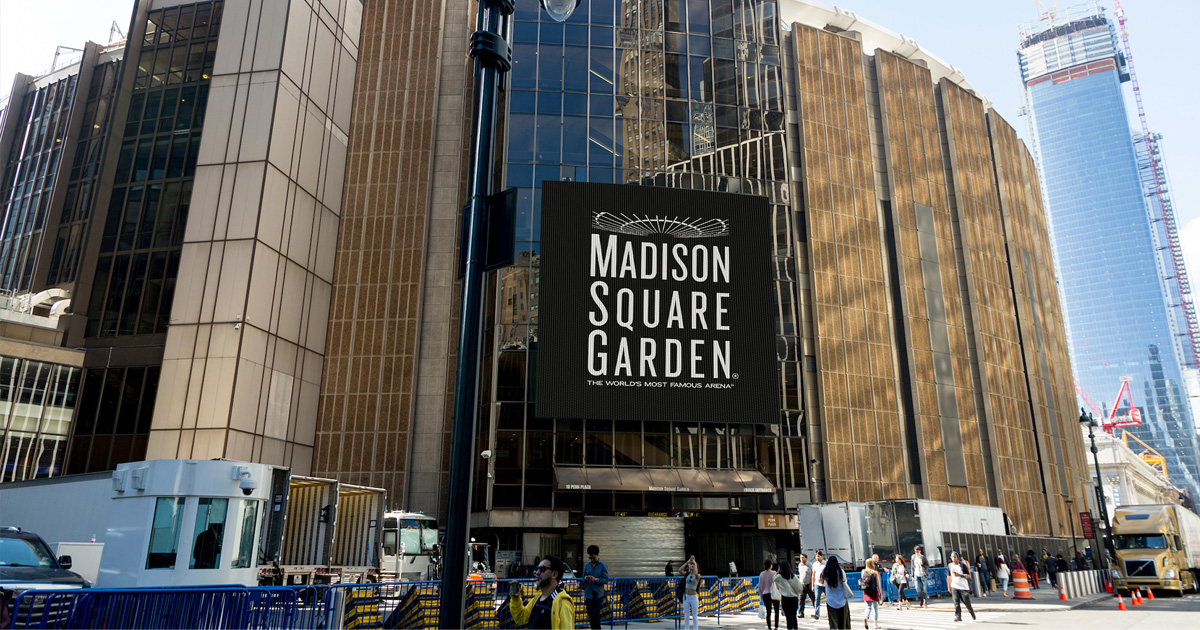
Bucket List of Basketball Venues
Twelve college and pro arenas and one high school gym that left a lifetime impression — starting with the Taj Mahal of basketball, Madison Square Garden.
A couple weeks ago I wrote a tribute to one of my childhood sports heroes, Bob Pettit. I mentioned how I went to St. Louis a few times to watch him and the St. Louis Hawks play in Kiel Auditorium. I mentioned as a freshman at the University of Missouri I got to play in Kiel when we played St. Louis University.
A friend of mine read the article and thought it was so "cool" that I got to play there and experience something like that. Several other viewers also shared how unique a venue that Kiel Auditorium was to them. That got me thinking about ALL the great, iconic places that I have been blessed to play in, coach in, or be a spectator. A bucket list, if you will, of basketball venues. I came up with 12 college and pro venues, and one high school gym that made a lifetime impression on me.
Madison Square Garden — New York
Madison Square Garden — the Mecca of basketball in New York City.
Topping my list is the most recognized and iconic indoor sports arena in the WORLD, MSG. Madison Square Garden in New York is special for a lot of reasons and one of those is that it was, for many years, the home to THE biggest college basketball tournament in the country. Yes, even bigger than the NCAA Tournament.
Up until the mid-1940's, the National Invitational Tournament (NIT) was bigger than the NCAA, due largely to where the tournament was held. When our Oral Roberts University Titans team played in the tournament in 1972 and 1973, there were only 16 teams invited to New York to play, the same as the NCAA. In 1954, the NCAA Championship game was televised, and soon after that, the expansion of the NCAA led to the shrinking interest in the NIT. They call Madison Square Garden the Taj Mahal for a reason.
(I made a few free throws and a couple jumpers during our team practice there as an assistant coach, just like Oscar, Wilt, West, and Walt.)
Kiel Auditorium — St. Louis
As I mentioned in my intro, Kiel Auditorium was a unique and special place to me as a Hawk fan and later as a player. I still remember the "special" player dressing room with the light bulbs around the mirror and riding the elevator down to the basketball court.
Chicago Stadium — Chicago
ORU did not belong to a conference and played as an "independent" during my stint as an assistant coach. We played games from California to New York and South Dakota to Brownsville, Texas (University of Texas-Pan American) so we played everywhere. The second most iconic place we played was in Chicago Stadium, home to the Bulls before United Center.
The building was built in 1929 for the Blackhawks and then in 1946 became the home of the Stags (Bulls). The "Madhouse on Madison" was the largest indoor arena in the world with a seating capacity of 26,000. We played Northern Illinois there as part of a double-header with UCLA and Loyola during the 1972-73 season. We lost that game, one of only 6 losses that year, but what I remember most is walking down the narrow tunnel that led to the stairs to go up to the court. I met Bill Walton in that tunnel as he was going up to play; he was a big dude.
The Forum — Los Angeles
I didn't play or coach in these NBA arenas, but the LA Forum, home to the Lakers, was a beautiful and special place. It just seemed like Hollywood to me.
The Checkerdome — St. Louis
Not as impressive but much bigger and just as unique was another basketball/hockey arena I went to several times, the Checkerdome in St. Louis. Before it was demolished in 1999 it was the home of the St. Louis Blues Hockey Team. The Hawks and Spirit basketball teams also played there. It was one of the largest indoor structures in the country.
I saw the greatest single player performance in my 70+ years of watching college basketball in that building. I was in the 17th row in March of 1973 and along with over 19,000 fans witnessed the unbelievable game by Bill Walton in the championship game of the NCAA Final Four. UCLA beat Memphis State by over 20 points. Walton missed only ONE field goal (21 of 22), scored 44 points and had 13 rebounds to totally dominate the game.
The other most iconic college arenas, fieldhouses, or gyms that I have seen basketball games in or visited are; Huff Gym on the campus of the U. of Illinois, Hinkle Fieldhouse in Indianapolis, Freedom Hall in Louisville, Rupp Arena in Lexington, Cameron Indoor at Duke, and the "granddaddy" of them all Phog Allen Fieldhouse in Lawrence, Kansas.
Huff Gym (Huff Hall) — Illinois
Huff Gym (Hall) is in my home state where the Illinois high school state tournament was played for 36 years before moving into Assembly Hall in 1963. The term "March Madness" was born in this gym during the state tournament held each March.
I also saw one of the greatest college teams ever play in this gym in 1961 when the #1 Ohio State Buckeyes, led by Jerry Lucas and John Havlicek, beat my Illini team by 30 points. One of the 5 best college teams of all time, in my opinion. The facility is still being used today, 100 years after it was built.
Rupp Arena — Lexington
One of the biggest upsets in NCAA Tournament history happened in Rupp Arena in 1985. Villanova played almost a perfect game and shot an unbelievable 78.6% in the championship game against the 9.5-point favorite Georgetown Hoyas. I was in the 4th row of the upper deck at about the center court line, sitting in disbelief as the Wildcats won by 2 points. Coach Rollie Massimino looking for someone, anyone to hug is seared in my brain.
Hinkle Fieldhouse — Indianapolis
Hinkle Fieldhouse in Indianapolis was the largest basketball arena in the country until 1950. It is perhaps best known for the movie Hoosiers. It is the home of the "mid-major" powerhouse team, the Butler Bulldogs. It is a designated National Historic Landmark. And yes, the basket is hung 10' from the floor.
Freedom Hall — Louisville
Freedom Hall in Louisville was the home court for the Louisville Cardinals from 1956 to 2010. The ABA Kentucky Colonels played there from 70-76. The huge building was originally built to host equestrian events, so the basketball court looks like a postage stamp on a 5 x 7 card. Freedom Hall has hosted six Final Fours.
Phog Allen Fieldhouse — Lawrence, Kansas
During my 6-year coaching stint at Butler CC in El Dorado, Kansas, I had an opportunity to spend a day with one of my all-time favorite coaches, Larry Brown. Coach Brown was gracious enough to let me spend a day with him and his staff at Kansas and watch a practice. As an assistant coach at Iowa State, I also know too well how tough a place "The Phog" can be for a visiting team. It has an iconic lobby where the original 13 rules of basketball written in 1891 by Dr. James Naismith are displayed. Phog Allen Fieldhouse is definitely a bucket list destination for any basketball fan.
Cameron Indoor Stadium — Durham
In 2019, my son treated me to one of the few sporting events left on my bucket list. He took me to see Duke at Cameron Indoor Stadium. Built in 1940 for less than a million dollars, the 9,314-seat gymnasium was the largest gym in the country, south of the Palestra in Philadelphia when it was built. The Duke Hall-of-Fame building that is next door to the gym is also a must see if you like basketball history. Seeing the "Cameron Crazies" in person is almost as entertaining as watching the team beat up their opponent in this "smallish facility" with the unbelievable atmosphere.
E.A. Diddle Arena — Bowling Green, Kentucky
The last arena that I want to mention is one that may seem "out of place" here BUT it has its own story. E.A. Diddle Arena in Bowling Green, Kentucky is the home of the Western Kentucky Hilltoppers and the home of a great basketball tradition. For many of you reading this you might think that Louisville and Kentucky are the only two colleges that play a high level of basketball in the state of Kentucky, but you would be mistaken.
Edgar Allen Diddle became the basketball coach at WKU in 1922 and retired from there after 42 years and a record of 759-302. His teams won 32 conference championships; his 1942 team played in the national championship game. WKU finished 3rd in the nation in 1948 and 4th in 1954. The Hilltoppers have been ranked in the basketball polls over 15 times. They were the FIRST Kentucky team to play in the NCAA and NIT Tournaments. The Hilltoppers play in the EA Diddle Arena that seats over 11,000.
And now for the rest of the story. I played my last collegiate basketball game in Diddle Arena before a full house of obnoxious, screaming fans. The Middle Tennessee State Blue Raiders, my school, had the misfortune of having to play Western on Senior night, the last game of the regular season. They had beaten us 30 points earlier in the season on our court. They were ranked in the top 10 in the country, had a great All-American player named Clem Haskins, and had only lost 2 games all year.
That night in early March could have been embarrassing, but we had a game plan to slow it down (Nova over Hoyas in the 1985 NCAA Finals) and keep them on defense. It worked perfectly; we were behind by 1 at half time. (I missed a field goal attempt at the buzzer, or we would have been ahead.) The second half was a bit tougher but even with 11,000 fans screaming their disapproval at our tactics, we played even with them to the end, losing by nine. It was the largest crowd I ever played before, a bitter-sweet memory. E.A. Diddle Arena is special to me. There were 11 times more people at that game than lived in my hometown of Galatia, IL.
Trout Gym — Centralia, Illinois
I would be remiss if I did not mention one high school gym that was very special and it wasn't because of the coaching success I had there. (My team only won one game in this gym.) The most iconic gym in Southern Illinois was Trout Gym in Centralia, Il. The Orphans have won over 2,400 basketball games, the most of any school in Illinois high school history. Arthur Trout, who coached there for 37 years, won 811 games and 3 state championships.
There was no greater atmosphere in the state than watching a high school basketball game in Trout. Trout Gym was built in 1936 and entertained the fans with some of the greatest players in the state for over 70 years. The best Christmas Holiday Tournament in the state was held in Trout. There are a few high school gyms in Illinois bigger and perhaps nicer, but none have the mystique of Trout Gym.
The stained window of two basketball players battling each other at the "hoop" draws the attention of any fan walking down the street, drawing them into the iconic lobby. Trophies, pictures, and jerseys are displayed from the days of "Dike" Eddelman, Bobby Joe Mason, Dickie Garrett, Russell Coleman, Roger Westbrook, Don Duncan, Herb Williams, Cliff Berger, and many other All-State and All-American players. A new high school was built, and the historic gym went silent in 2006. The stained-glass windows survived and were moved and installed in the new school some years later.
Most sports fans have a bucket list of events, people, places, etc.; my bucket list is not just a "check the box" but a reason to get excited about tomorrow. I haven't seen a basketball game at Assembly Hall at Indiana or watched an NBA game in Boston Garden, I know it's called TD Garden, but it will always be Boston Garden to me. Maybe an Indianapolis 500, the Olympics, a Kentucky Derby, a hockey game in Montreal, we will see; everyone needs something to look forward to.
Join the Discussion
What do you think? Did we miss anyone?
↓ Scroll down to comment ↓
Comments
No comments yet — be the first!
Never Miss a Story
Get an email when Jack publishes a new article. No spam — just basketball history.

