A Salute to My Childhood Hero
Remembering Bob Pettit — the St. Louis Hawks legend who set the standard for power forwards and taught a young Southern Illinois boy what greatness looked like.
Less than a month ago on September 23, 2026, Bob Pettit passed away at the age of 93. It may seem strange that a boy from Southern Illinois would be such a fan of one of the NBA's greatest players, who was from Louisiana. My connection to Pettit began when I was about 10-years old and Bob Pettit was an NBA star with the St. Louis Hawks. I was a diehard fan of anything that had to do with St. Louis, which included the Cardinals and the Hawks.
We would make the 100-mile trip from my home in Southern Illinois to Kiel Auditorium a couple of times a year to see the Hawks. I would have "big eyes" for the entire 2 hours that I was in Kiel, experiencing the atmosphere of the NBA and watching those great players. That is also the time when my dislike, that bordered on hatred, for the Boston Celtics took on a life. It wasn't that I didn't appreciate how great the Celtics were in the 50's and 60's; it was that MY Hawks couldn't beat them. (Except for 1958 and the herculean effort of Bob Pettit.) I was on cloud nine for a week; you would have thought that I made the winning basket.
On a side note, I got to play in Kiel Auditorium when I was a freshman at the University of Missouri, and we played the ST. Louis Bilikens. I probably dressed in the same individual player dressing room as Bob Pettit, hey, I can think that.
Bob Pettit is #25 in my book on the 75 greatest basketball players of all time. Tim Duncan is my "yardstick" for measuring power forwards, but Bob Pettit set the standard way back in 1956 when he entered the league. I have a bio that is in my book about Pettit, but there is one thing that I recently read about Pettit that I think every young aspiring athlete should hear.
"The greatest thing that ever happened to me is that when I first picked up a basketball, I was terrible." Pettit went on to say, "if things come naturally, you might not work hard at improving, and you fall short of your potential."
After being cut as gangly sophomore from the varsity, he spent that year playing in a church league. The following year he was All-City, as a senior he made All-State. He was an All-American at LSU where he led the Tigers to the Final Four in 1953. It helps if you are 6'9" but that alone will not make you the player that you have the potential to be.
#25 BOB PETTIT
Power Forward/Center | 6'9" | 1956-1967
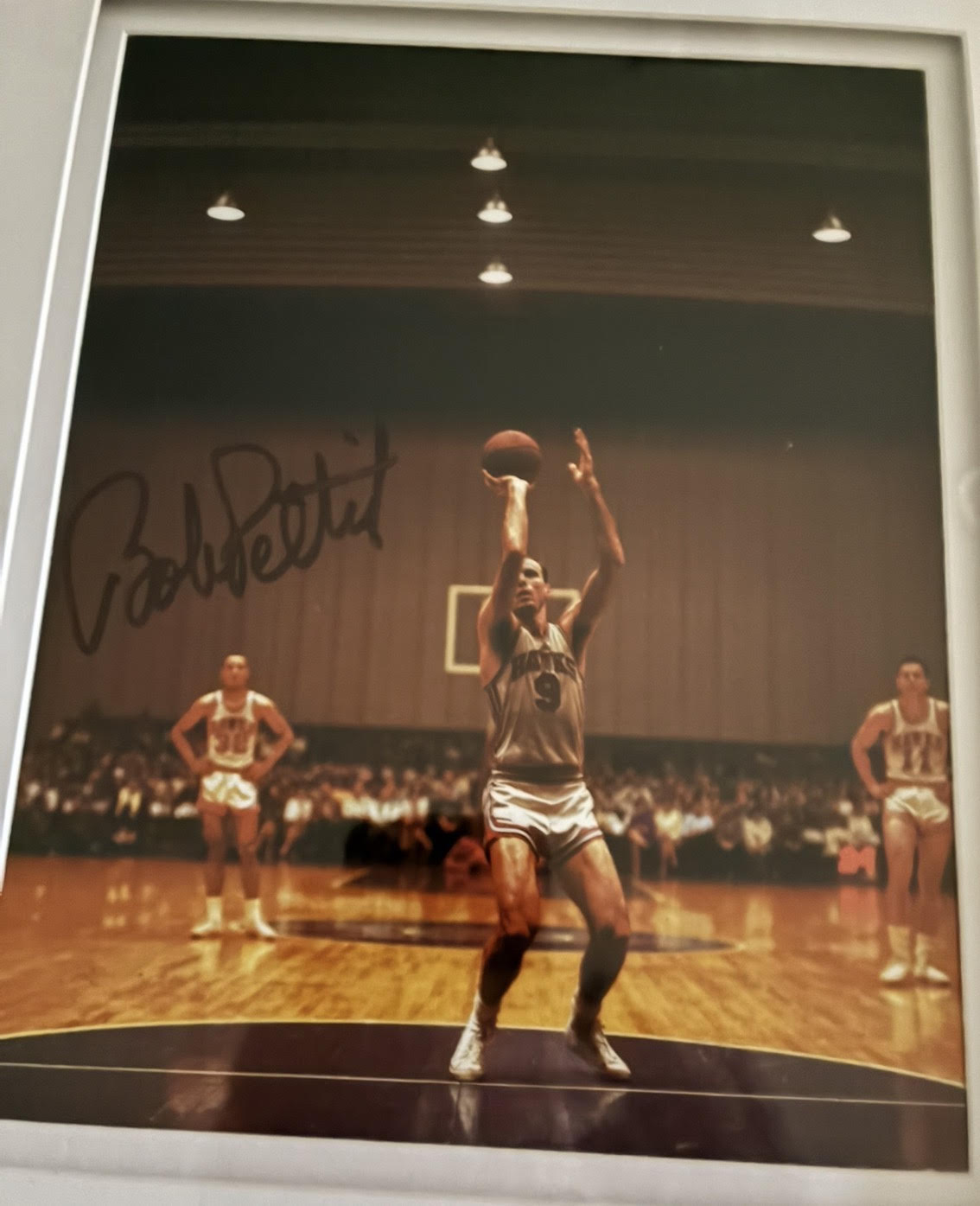
11x All-Star, 11x All-NBA, 2x Scoring Champion, 1x NBA Champion, ROY, 2x NBA MVP, 75th Anniversary NBA Team, Hall of Fame
I grew up about 100 miles from St. Louis and as a 10–11-year-old kid in the 50s when I was playing basketball on my outside dirt court, I was always Bob Pettit. He came into the NBA out of LSU with a great jump shot, a one-handed free throw shot, and an unbelievable competitive work ethic. Pettit was the first recipient of the NBA MVP award in 1956. He won the award again in 1959 and could have won it four straight years but the award was going to players on the Boston Celtics who were winning championships. (Cousy and Russell) In nine of his eleven years in the NBA Pettit finished in the top six in MVP voting.
Pettit led the league in scoring twice. Ironically, in the year he averaged over 31 points, he lost the scoring championship to Wilt Chamberlain who averaged an unbelievable 50.4 points per game. He is currently 41st all-time in scoring with 20,880 points (8th in average) and 18th all-time in rebounds with 12,849. Pettit was a great free throw shooter finishing 21st all-time in free throws attempted and made.
The decade of the 50s in the NBA belonged to the Boston Celtics and even though the St. Louis Hawks had good teams they could not consistently beat the Celtics. The Hawks did, however, beat them in 1958 and won the NBA Championship. Pettit scored 50 points in the final game.
◆ The Gem: Pettit is the only player in the history of the NBA to be named to the All-NBA team every year he was in the league — all 11 seasons. He was also the first player to score over 20,000 points in the NBA.
Join the Discussion
Do you agree with Jack's take? Who would you rank differently?
↓ Scroll down to comment ↓
Comments
No comments yet — be the first!
Never Miss a Story
Get an email when Jack publishes a new article. No spam — just basketball history.

